
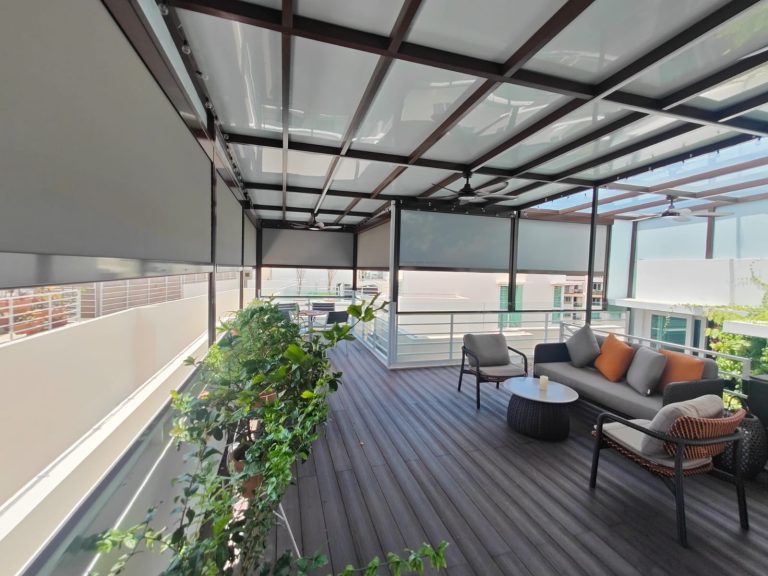
If you’ve been comparing ACP (Aluminum Composite Panel) and polycarbonate roofing, you’ve probably already read the basics: one’s opaque, one’s see-through, one’s for facades, one’s for skylights. But the question that actually matters for a long-term investment is simpler and scarier: what does this material look like in ten years?
Here’s the technical breakdown, including the yellowing problem nobody warns you about.
Does ACP or Polycarbonate turn yellow after a few years?
Polycarbonate can yellow. ACP doesn’t — but not for the reason most people assume, and it’s worth understanding why if you want to avoid buying the wrong grade of either material.
Why Polycarbonate Turns Yellow
Polycarbonate is an organic polymer, and organic polymers have a weakness: UV radiation attacks their molecular structure. Specifically, UV photons trigger what’s called photo-oxidative degradation. Radiation breaks down the polymer backbone through Norrish Type I/II reactions, generating free radicals. Those radicals react with oxygen and form chromophores — light-absorbing molecular groups that shift the material’s absorption into the visible spectrum. The result is the yellow tint you’ve probably seen on old greenhouse panels or carport roofs.
It doesn’t stop there. Surface micro-cracking (crazing) develops alongside the discoloration, scattering light and making the whole sheet look hazy on top of yellow.
This is exactly why quality polycarbonate sheets include a co-extruded UV-resistant layer — typically 30 to 50 microns thick — on the exposed face. This layer contains UV absorbers, commonly benzophenones or benzotriazoles, that sacrificially soak up radiation before it reaches the bulk material underneath.
The difference this layer makes is dramatic:
- Without UV protection: noticeable yellowing within 2–5 years
- With genuine co-extruded UV coating: 10–15 years before significant yellowing, sometimes longer with premium brands like Palram, Gallina, or Danpalon
The catch: cheaper sheets sold in some markets skip this layer entirely, or use a sprayed-on coating instead of a co-extruded one. That’s the single biggest cause of yellowing complaints — and it’s often invisible until you’ve already installed the roof.
Why ACP Doesn’t Yellow the Same Way
ACP’s exposed surface isn’t a clear polymer letting UV pass through — it’s a pigmented, opaque coating over an aluminum core, usually PVDF (polyvinylidene fluoride) or PE (polyethylene).
- PVDF-coated ACP uses an extremely UV-stable fluoropolymer coating (the branded resin Kynar 500 is common). Color retention runs 15–20+ years with minimal chalking or fading.
- PE-coated ACP is cheaper and far less UV-resistant. It will fade or chalk over 5–8 years, especially in dark colors.
Because the coating is opaque and pigmented, degradation shows up as chalking or gloss loss rather than yellowing. It’s a different failure mode entirely — which is why comparing “yellowing resistance” between ACP and polycarbonate isn’t quite apples to apples.
Full Technical Comparison
| Property | ACP | Polycarbonate (multiwall) |
|---|---|---|
| Thickness (typical) | 3–6mm (0.2–0.5mm aluminum skins) | 6–25mm |
| Weight | ~5.5 kg/m² (4mm panel) | ~1.5–3 kg/m² (10mm twin-wall) |
| Light transmission | 0% | 35–90%, depending on type/color |
| Impact strength | Good, but dents under sharp impact | Excellent — roughly 200x the impact resistance of glass |
| Fire rating | Varies hugely by core type: fire-retardant (FR) core hits B1/A2, but PE-core panels are combustible and banned in many facade codes post-Grenfell | Generally self-extinguishing but still combustible; fire-rated grades can achieve B-s1/d0 |
| Thermal expansion | ~2.4 × 10⁻⁵ /°C (aluminum-dominated, low movement) | ~6.5 × 10⁻⁵ /°C — nearly 3x more movement, requires expansion gaps |
| Max sheet size | Large panels, widths 1220–1575mm, long lengths | Standard widths ~2.1m, various lengths |
| Insulation (U-value) | Poor on its own unless part of a composite wall system | Decent — trapped air in multiwall channels gives 10mm twin-wall roughly U-3.6 W/m²K |
| Sound insulation | Moderate | Poor to moderate unless laminated or thick |
| Typical warranty | 10–20 years on coating (quality product) | 10 years on UV/structural performance; clarity warranty sometimes shorter |
The Installation Detail That Gets Overlooked
Because polycarbonate expands and contracts nearly three times more than aluminum with temperature changes, roofing installations need oversized screw holes and thermal movement allowance — roughly 3mm per meter of sheet length. Skipping this is one of the most common installation mistakes, and it’s why polycarbonate roofs crack at the fixing points long before the material itself degrades.
Bottom Line
If you’re choosing based on longevity and appearance over time:
- ACP holds its color better overall, especially with a PVDF coating, but check the core material for fire safety compliance.
- Polycarbonate can match ACP’s lifespan in terms of not visibly degrading, but only if you pay for genuine co-extruded UV protection — and even then, proper installation with expansion allowance is what determines whether it survives to see that lifespan.
The real lesson: the spec sheet number for “UV resistance” or “coating type” matters more than the base material itself. A cheap polycarbonate sheet and a cheap PE-coated ACP panel will both disappoint you within five years — just in different ways.
