
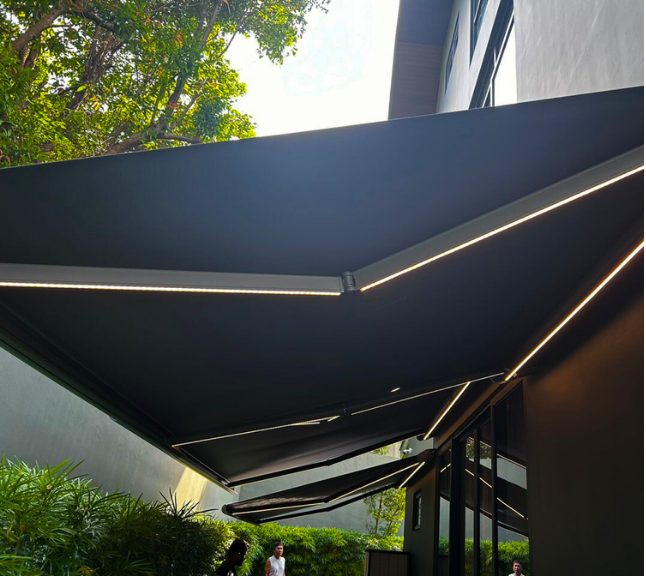
Retractable awnings are a popular choice for homeowners and businesses that want shade and rain protection without permanently covering an outdoor area. Unlike a fixed awning, a retractable system can be extended when protection is needed and retracted when you want more sunlight, ventilation or an unobstructed view.
At Roofers Home & Decor, we supply and install retractable awnings for balconies, patios, terraces, windows, outdoor seating areas, entrances and other residential and commercial spaces in Singapore.
However, retractable awnings are not automatically suitable for every property. They have clear advantages, but they also involve mechanical components, maintenance requirements, weather limitations and installation considerations that should be understood before making a decision.
The important question is not simply whether retractable awnings are good or bad. It is whether the advantages match the way you intend to use your space.
| Pros | Cons |
|---|---|
| Adjustable shade and sunlight control | Higher initial cost than basic fixed awnings |
| Can improve comfort in outdoor areas | Requires cleaning and periodic maintenance |
| Can reduce direct sun exposure | Strong winds may require the awning to be retracted |
| Provides some protection from light rain | Not a replacement for a heavy-duty permanent roof |
| Manual and motorised options available | Motorised systems contain more components |
| Can protect furniture from direct sunlight | Fabric can collect dirt and moisture |
| Retracts when an open area is preferred | Size and projection are limited by the system and site |
| Can complement a property’s appearance | Incorrect installation can affect performance and durability |
What Is a Retractable Awning?
A retractable awning is an outdoor shading system designed to extend and retract from a mounting position on the building.
A typical system includes a fabric covering, roller tube, support arms, brackets and an operating mechanism. Motorised models also include an electric motor and control system.
For example, one common reference size for retractable-awning pricing is 3m wide × 2m projection, which provides a nominal coverage footprint of approximately 6m² when fully extended. Roofers’ current Singapore pricing guide uses this size as a reference for manual and motorised retractable-awning price ranges.
The actual dimensions available for your property depend on the awning system, available mounting area, required projection, structural conditions and the manufacturer’s specifications.
Pros of Retractable Awnings
1. You Can Control Shade Whenever You Need It
The biggest advantage is flexibility.
A fixed awning remains in position throughout the day. A retractable system lets you decide when the outdoor area should be shaded.
You might extend it in the afternoon when sunlight is strongest, then retract it later in the evening when you want an open view.
This makes retractable awnings particularly useful for:
- Balconies
- Patios
- Terraces
- Outdoor dining spaces
- Shopfronts
- Windows and doors
- Outdoor seating areas
For homeowners who do not want permanent overhead coverage, this flexibility can make a significant difference.
2. Can Make Outdoor Areas More Comfortable
Direct sunlight can make an otherwise usable balcony or patio uncomfortable.
By creating shade over the area, a retractable awning can reduce direct solar exposure and make the space more practical for sitting, dining and entertaining.
The actual effect varies from property to property. Building orientation, surrounding structures, awning projection, fabric colour and coverage all affect performance.
This is why we avoid promising a universal temperature reduction. A professionally sized awning should instead be designed around the actual sun exposure and the area you want to shade.
3. Can Reduce Direct Sunlight Through Windows and Doors
When an awning is positioned outside a window or glass door, it can shade the opening from direct sunlight.
This can be useful where strong sunlight enters a room at particular times of the day.
External shading can also help protect nearby furniture, curtains, flooring and outdoor furnishings from prolonged direct sunlight. The awning does not completely prevent fading or deterioration, but it can reduce direct exposure when extended.
4. Offers Some Protection From Light Rain
A retractable awning can provide useful shelter during light rain and short showers.
For a balcony or patio, this can allow the space to remain usable when the weather is less than ideal.
There is an important limitation, however.
A retractable awning should not automatically be treated as a permanent weatherproof roof.
Heavy rain, strong winds and severe weather can create conditions in which the awning should be retracted. The fabric, arms, brackets and mounting points are all affected by weather exposure.
At Roofers, we explain the intended operating conditions so customers understand when the awning should remain open and when it should be retracted.
5. Motorisation Makes Operation Easier
Manual retractable awnings are operated by a hand mechanism, while motorised awnings use an electric motor.
Motorisation can be particularly useful when the awning is large, positioned high or used frequently.
Instead of manually opening the system, the user can operate it using the supplied control system.
For Singapore installations, the electrical supply and motor specification need to be compatible with the property. A typical local electrical supply is 230V, 50Hz, but the exact motor and control equipment must always be checked against the selected system rather than assumed.
Motorisation provides convenience, but it also adds cost and components that may eventually require servicing.
6. Retractable Systems Can Be Visually Less Permanent
Some homeowners like having the ability to make the awning almost disappear when it is not needed.
When retracted, the outdoor area can appear more open than it would with a permanent roof.
This can be especially useful for homes where maintaining an open balcony or patio is important.
The visual result also depends on the cassette, frame colour, fabric and mounting position.
Cons of Retractable Awnings
7. Higher Initial Cost
Retractable systems generally cost more than very basic fixed shading solutions because they contain additional hardware and an operating mechanism.
Roofers’ current Singapore price guide gives indicative supply-and-installation ranges of approximately S$1,800–S$3,500 for a manual 3m × 2m retractable awning and approximately S$3,500–S$6,500 for a motorised 3m × 2m system. These are planning ranges rather than fixed quotations; actual pricing depends on the project specification and site conditions.
The cost can change according to:
- Width and projection
- Fabric specification
- Frame and support system
- Manual or motorised operation
- Mounting conditions
- Electrical work
- Access requirements
- Additional controls or accessories
- Drainage requirements
This is why comparing only the final quotation price can produce a misleading result.
8. It Requires Maintenance
Retractable awnings are exposed to Singapore’s outdoor environment.
Dust, dirt, leaves, moisture and other contaminants can accumulate on the fabric and mechanical components.
Routine maintenance should include inspecting the:
- Fabric
- Roller mechanism
- Support arms
- Mounting brackets
- Motor where applicable
- Controls
- Drainage components where installed
Cleaning should be carried out using methods suitable for the fabric and manufacturer’s instructions.
Maintenance is particularly important for retractable systems because they contain moving parts that do not exist in a simple fixed roof.
9. Strong Winds Can Limit When You Use It
This is one of the most important disadvantages.
When an awning is fully extended, wind can act on the fabric like a large outdoor surface. The force is transferred through the support arms, brackets and mounting points.
This is why customers should ask about the operating limitations of the specific system rather than assuming every retractable awning can remain extended in strong wind.
Some motorised systems can be equipped with automatic wind-sensing features, but this does not remove the need for proper installation or responsible operation.
When weather conditions become unsuitable, retracting the awning reduces exposure to wind loading.
10. A Retractable Awning Is Not a Heavy-Duty Roof
A retractable awning is designed primarily for flexible shading and weather protection.
If your main requirement is permanent coverage over an outdoor area, a fixed polycarbonate roof, ACP structure, glass canopy or another permanent roofing solution may be more appropriate.
This distinction matters because customers sometimes expect a retractable awning to behave like a permanent structural roof.
The design, materials, drainage system and allowable operating conditions are different.
11. Mechanical Parts Can Eventually Require Servicing
A manual awning has fewer electrical components.
A motorised system can include an electric motor, controls, wiring and optional sensors. These parts improve convenience, but they also add more components that can potentially need repair or replacement over the system’s service life.
When choosing a motorised awning, we recommend asking:
Who handles the after-sales service?
What happens if the motor develops a fault?
Are replacement parts available?
What does the warranty cover?
Does Retractable awning collect mold and mildew?
When to Use a Professional Mold Remediation Service
If you catch mold early, you can often clean it yourself with mild soap and a soft brush. However, if the mold infestation is severe, returning repeatedly, or covering a large area, calling in a professional mold remediation service or a specialized awning cleaner is the best route.
These questions are just as important as the original purchase price.
12. The Available Size Is Limited by the Site
You cannot assume that a retractable awning can be made to any width or projection.
The size must match the selected system and the installation conditions.
For example, a 2m projection extends two metres outward from the mounting line when fully deployed. The actual usable coverage is affected by the pitch, fabric dimensions, front bar position and surrounding obstacles.
Doors, windows, railings, neighbouring structures and property boundaries can all affect the final design.
This is why we recommend measuring the site before selecting the final system.
Technical Consideration 1: Projection and Pitch
Two technical measurements are particularly important: projection and pitch.
Projection is the distance the awning extends outward.
Pitch is the angle at which the awning slopes downward from the mounting position.
The pitch influences both head clearance and rainwater movement.
As an illustration, a 2m projection at a 10° pitch produces a vertical drop of approximately 350mm using basic geometry. At 15°, the same 2m projection produces a drop of approximately 536mm.
These are calculation examples, not universal installation requirements.
The actual pitch must be selected according to the awning design, mounting height, required clearance, manufacturer specifications and site conditions.
A steeper pitch can improve rainwater movement, but it also reduces the available headroom at the front of the awning.
This is why awning installation involves more than simply fixing the brackets at a convenient height.
Technical Consideration 2: Fixing and Load Transfer
The brackets are responsible for transferring loads from the awning into the building.
The fixing strategy therefore needs to be matched to the actual substrate.
Before installation, we consider the available mounting surface, bracket locations, projection, overall awning size and existing building conditions.
A large awning creates different forces at the mounting points compared with a small awning.
For this reason, we do not recommend selecting anchors or fixing positions purely from appearance.
The important questions are:
What is the mounting substrate?
Where will the brackets be installed?
Are there suitable fixing points?
Does the selected system match the available structure?
Has the site been inspected before fabrication?
A proper site assessment reduces the risk of discovering installation problems after the awning has already been manufactured.
Manual vs Motorised Retractable Awnings
| Feature | Manual | Motorised |
|---|---|---|
| Operation | Hand mechanism | Electric motor |
| Initial cost | Lower | Higher |
| Convenience | Good for occasional use | Better for frequent use |
| Electrical connection | Not normally needed for operation | Required |
| Components | Fewer | More |
| Maintenance | Generally simpler | More components to inspect |
| Best suited for | Smaller or occasional-use systems | Larger or frequently used systems |
Neither is automatically the better choice.
A homeowner who operates the awning occasionally may be perfectly comfortable with a manual system.
Someone with a wide balcony awning that is opened and closed frequently may prefer motorisation for convenience.
How to Decide Whether a Retractable Awning Is Right for You
A retractable awning may make sense when your priorities include:
Flexible shade
You want to change the amount of coverage throughout the day.
An open outdoor space
You want the option to retract the awning completely.
Light rain protection
You need some shelter without building a permanent roof.
Convenience
You want manual or motorised operation.
Aesthetics
You want a shading solution that can be retracted when not required.
A different solution may be more suitable when you need:
- Permanent heavy rain protection
- Full coverage over a very large area
- A fixed roof structure
- Minimal moving parts
- A structure designed to remain permanently covered
At Roofers, we can compare these options based on the actual space rather than assuming a retractable system is appropriate for every project.
What Should You Ask Before Buying a Retractable Awning?
Before signing a quotation, ask your contractor:
- What exact width and projection are proposed?
- What fabric or covering material will be supplied?
- What is the pitch when fully extended?
- Where will the brackets be fixed?
- What type of substrate is being used for fixing?
- How will rainwater move off the awning?
- Is drainage included?
- Is the system manual or motorised?
- What electrical requirements apply?
- What happens during strong winds?
- What maintenance is required?
- What does the warranty cover?
- Who handles repairs?
- What is included in the installation price?
- Are there any property-specific requirements that need to be checked?
A contractor who can answer these questions clearly gives you a much better basis for making a decision.
Our Approach at Roofers
At Roofers Home & Decor, we do not believe every balcony, patio or terrace should receive the same retractable awning.
We first look at the actual property and understand how the space will be used.
We consider:
Site dimensions
Required projection
Mounting location
Fixing conditions
Sun exposure
Rainwater movement
Manual or motorised operation
Required coverage
Maintenance requirements
From there, we can recommend a system that matches the space and the customer’s priorities.
For some properties, a retractable awning provides the right balance between shade and flexibility.
For others, a fixed awning or permanent roofing system may make more sense.
Our job is not simply to sell an awning. It is to help you choose a system that is practical for the property, suitable for the intended use and properly installed.
Final Thoughts: Are Retractable Awnings Worth It?
Retractable awnings provide an important advantage: control.
You can create shade when sunlight is strong, obtain some protection from light rain, and retract the awning when you want an open outdoor space.
The disadvantages are the higher upfront cost, maintenance requirements, moving parts, weather limitations and restrictions on size and installation conditions.
The technical details matter just as much as the appearance. Width, projection, pitch, mounting height, fixing points and drainage all influence how the completed installation performs.
At Roofers Home & Decor, we approach every retractable-awning project based on the actual site and intended use. We can assess your space, explain the available options and provide an itemised quotation based on the required specification.
A retractable awning should not simply look good when it is installed.
It should be correctly sized, properly supported, easy to operate and appropriate for the way you actually use your outdoor space.
